You’ve got an aluminum job on the table — maybe it’s a boat trailer repair, a set of custom truck toolboxes, or structural channel work on a commercial build — and your current MIG welder is handling steel just fine. Someone mentions a spool gun. You do a quick search, find one that fits your machine’s brand, and almost pull the trigger before realizing: will my machine actually support this thing?
That’s the question more welders run into than the manufacturers like to advertise. A spool gun (a self-contained wire-feeding attachment that holds a small spool of aluminum wire close to the arc, solving the “bird’s nest” jamming problem that happens when soft aluminum wire travels through a long MIG gun liner) only works if your welder has a dedicated spool gun port, the right trigger circuit, and — critically — the correct voltage sensing setup. Some machines have all of that. Many don’t. This guide breaks down which mid-market and professional multi-process machines are genuinely spool-gun-ready, what to verify before you buy, and how to make the right call for your shop.
| EDITOR'S PICK[Lincoln Electric Power MIG 211i](https://www.amazon.com/dp/B0BTMVVG35?tag=greenflower20-20)… | Mid-tier[ARCCAPTAIN MIG Welder](https://www.amazon.com/dp/B0B1TGZ8XN?tag=greenflower20-20) | Budget pick[YESWELDER 205A MIG Welder](https://www.amazon.com/dp/B07TVCWDGW?tag=greenflower20-20) | |
|---|---|---|---|
| Max Amps | 211 A | 200 A | 205 A |
| Voltage | 120/230 V | 110/220 V | 110/220 V |
| Weight | 41 lb | — | — |
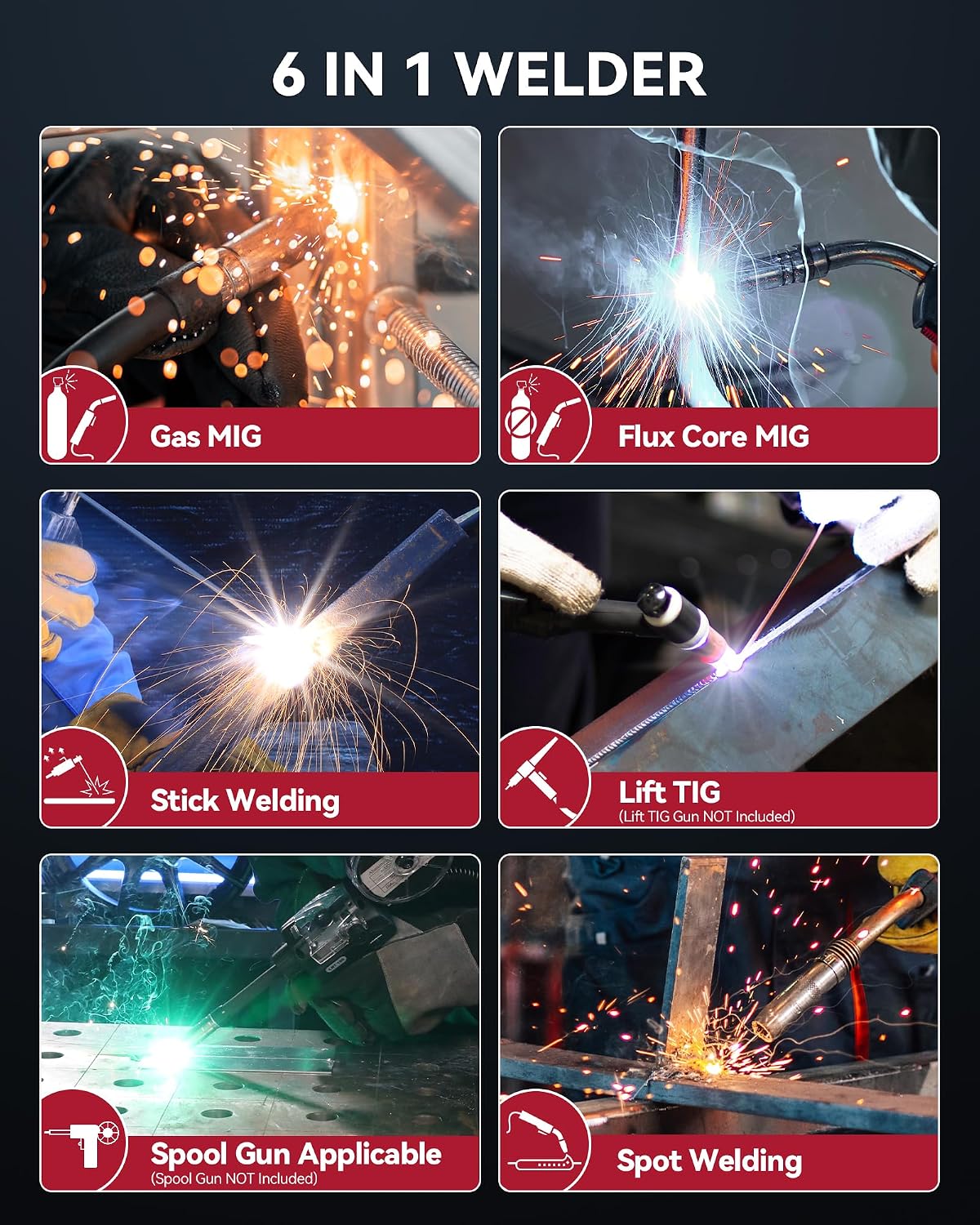
| Processes | MIG, Flux-Cored | 6 in 1: MIG, Flux, Stick, TIG, Spot, Spool | 5 in 1: MIG, Flux, Spool, TIG, Stick |
| Spool Gun Ready | — | ✓ | ✓ |
| Display | — | LED | LED |
| Price | $1,599.00 | $369.99 | $339.99 |
| See on Amazon → | See on Amazon → | See on Amazon → |
Why Aluminum Needs a Different Wire Delivery Setup
Steel MIG wire is stiff enough to push through 10 or 15 feet of conduit liner without kinking. Aluminum wire — typically 4043 or 5356 alloy, in .030” or .035” diameter — is soft and sticky. It wants to compress, buckle, and jam inside a standard push-only MIG gun. The result is a birdsnest of tangled wire at the drive rolls, a weld that stops mid-bead, and a lot of frustration.
The spool gun solves this by putting a small, 1-lb spool of wire right at the gun itself. Wire only travels 2–4 inches from spool to contact tip, which eliminates the feeding problem entirely. But that elegance comes with a machine-side requirement: the welder needs a dedicated spool gun port (usually a 14-pin or proprietary connector), a switched trigger circuit to disengage the machine’s main wire feeder, and voltage output tuned for the aluminum-appropriate parameters you’re running. Without all three, you’re either buying a gun that won’t physically connect, one that won’t trigger correctly, or one that feeds wire when you don’t want it to.
The American Welding Society’s D1.2 Structural Welding Code for Aluminum reinforces why this matters on professional work: process control and consistent wire feed rate are critical quality variables in aluminum welds, especially in structural applications. Getting the machine-to-gun interface right isn’t just a convenience — it’s a quality control issue.
The Compatibility Question: What to Actually Check
Before matching a spool gun to a machine, verify these four things. No exceptions.
1. Dedicated spool gun port or OEM adapter availability. This is the hard gate. Machines either have it or they don’t. A dedicated port is typically a secondary connection point — separate from the standard MIG torch receptacle — with pins for the trigger circuit, contactor control, and sometimes gas solenoid. If your machine doesn’t have this port and the manufacturer doesn’t offer an adapter kit, you’re done. Don’t try to wire around it.
2. Trigger switching. When you plug in a spool gun, the machine needs to know to disable the internal wire feeder and hand control to the gun. On machines with proper spool gun support, flipping a switch or plugging into the correct port handles this automatically. On machines without it, both the internal feeder and the spool gun can try to run simultaneously — a quick way to damage drive rolls and burn out motor circuits.
3. Wire speed and voltage range for aluminum. Aluminum runs at higher wire feed speeds than steel for the same amperage. A machine rated for 30–400 IPM (inches per minute) on its panel should be verified against the spool gun manufacturer’s recommended range for aluminum. Miller’s Spoolmate 100 Series documentation, for example, specifies compatible wire feed speed ranges for each paired machine — a detail worth cross-referencing, not assuming.
4. OEM spool gun vs. third-party. Manufacturers design their spool guns to work with their specific pin configurations and contactor logic. Third-party spool guns can work with adapters, but operators in long-run reviews consistently note intermittent trigger issues and feed inconsistencies that disappear when switching to the OEM gun. For production work, OEM is worth the price premium.
Which Machines Are Actually Spool-Gun Ready
Here’s where the rubber meets the road. The market is full of “multi-process” machines that technically run MIG, TIG, and Stick — but spool gun aluminum capability is a separate box to check.
Miller Machines: Strong Native Support
Miller has built spool gun compatibility into a wide range of their lineup, and their Spoolmate series (100SG, 150S, 200) are matched specifically to machine families. The Millermatic 211 and 252 both carry a dedicated spool gun port and are explicitly rated for the Spoolmate 100SG per Miller Electric’s published compatibility documentation on millerwelds.com. The Multimatic 215 and 220 similarly support the Spoolmate 100SG out of the box. At the professional tier, the Multimatic 255 supports the Spoolmate 200, which handles .030”–.047” wire and is designed for heavier aluminum work.
One key detail from Miller’s documentation: some older Millermatic models require a specific adapter cord (the 300497 or equivalent) to connect the Spoolmate properly. Always verify the adapter requirement before assuming plug-and-play.
Lincoln Electric: Solid but Model-Specific
Lincoln’s Magnum PRO 100SG spool gun is compatible with several of their machines, but the match list is tighter than Miller’s. Per Lincoln Electric’s product documentation on lincolnelectric.com, the Power MIG 210 MP and Power MIG 260 are confirmed compatible. The 210 MP is a popular mid-market choice for shops doing mixed work — steel fab plus occasional aluminum — and Lincoln’s spec sheet confirms the 14-pin spool gun port is standard.
Where Lincoln owners run into trouble is with older or entry-level machines like some variants of the Handy MIG or older SP-series. These lack the trigger switching circuit and spool gun port entirely. The brand loyalty instinct to pair a Lincoln gun with a Lincoln machine is correct — the issue is confirming which Lincoln machine, not just assuming the brand match covers it.
ESAB Rebel EMP 235ic: A Practical Middle-Ground
The ESAB Rebel EMP 235ic has earned a strong reputation as a versatile multi-process machine in the $1,200–$1,800 range, and ESAB’s published specifications on esabna.com confirm spool gun compatibility via their SA-17 spool gun. The machine includes a spool gun port, and ESAB’s sMIG (Smart MIG) technology adjusts arc parameters automatically — which operators in published reviews note makes aluminum parameter dialing somewhat more forgiving for welders who aren’t running aluminum daily.
One honest trade-off: the Rebel’s 230-amp output ceiling (at 60% duty cycle — meaning it can sustain the arc at that power level for 6 out of every 10 minutes before needing a cooldown pause) is adequate for aluminum plate up to roughly 3/8” but starts limiting you on thicker structural work. For most shop applications, that’s fine. For heavy structural aluminum fabrication, you’re looking at a larger machine.
Fronius and the High-End Tier
At the $5,000–$12,000 professional tier, Fronius’s TPS/i platform handles aluminum via push-pull gun systems rather than traditional spool guns — a setup where the wire feeder in the machine and a motor in the gun work together to maintain consistent wire tension over longer distances. This is the preferred approach for production aluminum welding on longer gun cables. Per Fronius’s TPS/i technical documentation on fronius.com, the system supports PMC (Pulse Multi Control) aluminum welding with significantly tighter arc control than a standard spool gun setup. If you’re doing high-volume aluminum fabrication or aerospace-adjacent work where bead consistency is a quality requirement, the push-pull route is worth the investment. For occasional aluminum work on a mixed-material shop floor, a spool gun on a mid-market machine gets the job done.
By the Numbers
| Machine | Spool Gun | Port Type | Max Output | Est. Street Price (2026) |
|---|---|---|---|---|
| Miller Multimatic 215 | Spoolmate 100SG | Dedicated 14-pin | 230A | ~$1,100 |
| Lincoln Power MIG 210 MP | Magnum PRO 100SG | Dedicated 14-pin | 220A | ~$1,050 |
| ESAB Rebel EMP 235ic | SA-17 Spool Gun | Dedicated port | 235A | ~$1,400 |
| Miller Multimatic 255 | Spoolmate 200 | Dedicated 14-pin | 275A | ~$2,200 |
| Fronius TPS/i 270 | Push-pull (OEM) | Integrated system | 270A | ~$7,500+ |
Street prices based on distributor listings aggregated from Grainger, Airgas, and Baker’s Gas as of mid-2026. Prices vary by region and volume.
The Total Cost of Ownership Math
The machine is only part of the bill. A spool gun adds $200–$450 depending on brand and capacity. Pure argon shielding gas (100% Ar is required for aluminum MIG — the CO2 blends used for steel will cause porosity and a rough, contaminated bead) typically runs $30–$55 per cylinder fill at current distributor rates, and aluminum burns through gas faster than steel work of equivalent duration. Factor in .030” or .035” 4043 or 5356 aluminum wire at roughly $8–$14 per pound, and contact tips — aluminum needs more frequent tip changes than steel due to the softer wire expanding in the tip — at $10–$20 per pack of 10.
For a shop running aluminum quarterly on fabrication jobs, the spool gun + compatible mid-market machine setup pencils out well. For a shop running aluminum multiple days per week at volume, the jump to a push-pull system on a higher-amperage machine starts making TCO sense within 18–24 months.
The Decision Rule
Here’s the clean “if X, then Y” frame based on what the published specs and operator patterns show:
-
If you’re doing occasional aluminum work (less than 10% of arc-on time) on plate up to 1/4”, a spool gun on the Miller Multimatic 215, Lincoln Power MIG 210 MP, or ESAB Rebel EMP 235ic is the right call. Verify the compatible OEM gun, confirm the port is present on your specific machine variant, and budget for the gun + pure argon setup.
-
If aluminum is 20%+ of your work or you’re regularly welding 3/8” and thicker, step up to the Miller Multimatic 255 with the Spoolmate 200, or start evaluating push-pull options at the $3,000–$5,000 machine tier.
-
If you’re doing production-volume aluminum or any certified structural aluminum work per AWS D1.2, the Fronius TPS/i push-pull system — or an equivalent high-duty-cycle platform — is where the process control requirements point you. The cost is real; so is the quality delta.
The spool gun path is genuinely capable of good aluminum work when the machine supports it properly. The mistake to avoid is assuming the word “multi-process” on the spec sheet means spool gun ready. Check the port. Verify the OEM gun match. Run pure argon. The rest is technique.