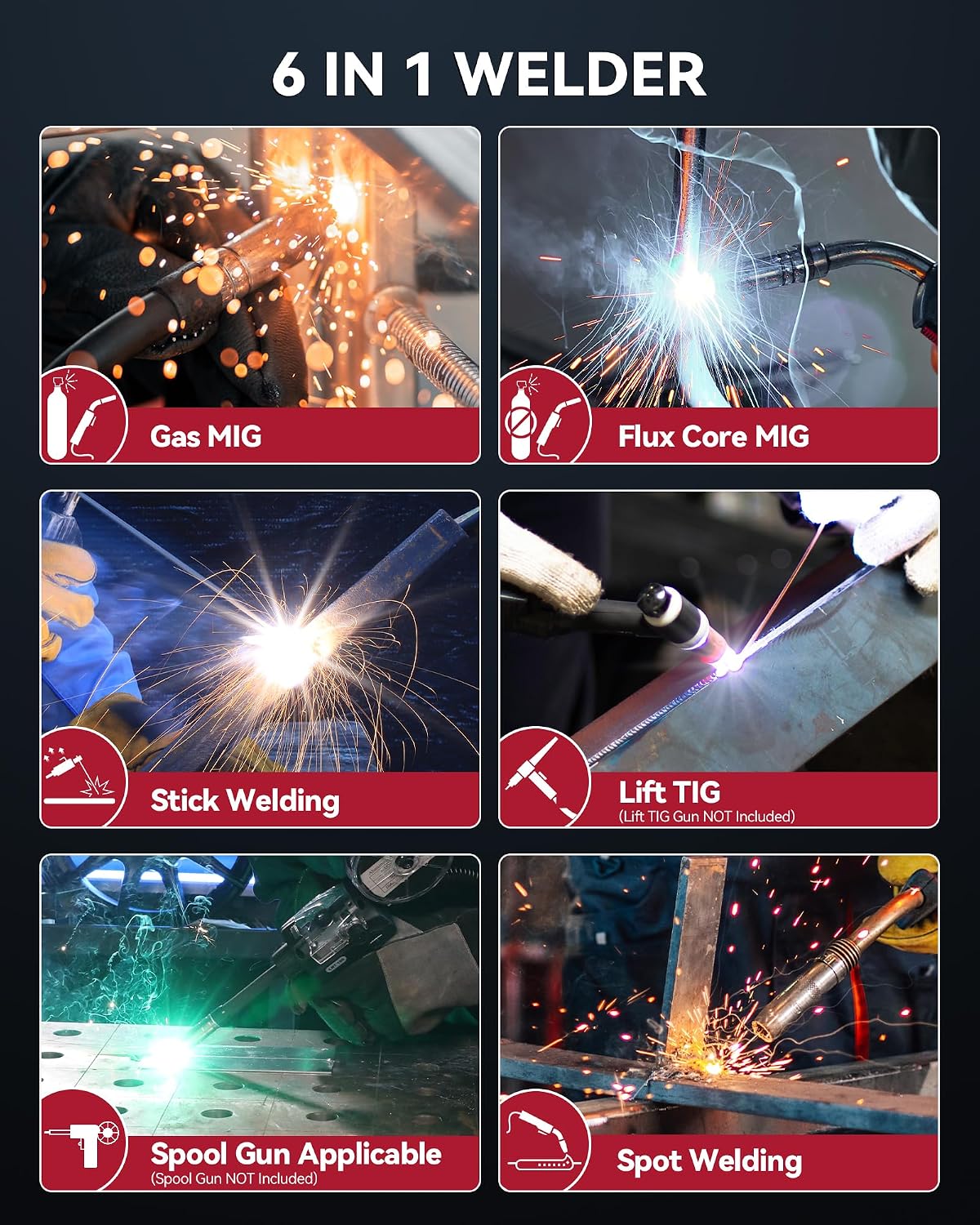
Imagine you’re building out a small fabrication shop — a two-bay operation, maybe one or two employees, a mix of structural steel, aluminum, and the occasional stainless job coming through the door. Someone tells you that serious welders own separate machines: a dedicated MIG welder (a machine that feeds a continuous wire electrode to join metal — fast, forgiving, great for production), a TIG welder (a process that uses a non-consumable tungsten electrode for precise, clean welds on thinner or exotic metals), and a stick welder (the oldest process, which uses a coated rod that melts into the joint — rugged, portable, works outdoors in wind). That’s three power supplies, three sets of consumables, three warranty contracts, and somewhere between $4,000 and $12,000 in upfront cost depending on the tier you’re buying at. Or — you buy one multi-process welder, a single machine capable of switching between MIG, TIG, and stick from the same chassis. This article is going to show you exactly when that trade-off makes financial sense, where it doesn’t, and how to run the numbers for your specific shop before you sign anything.
| EDITOR'S PICK[Miller 907757 Multimatic 220 AC…](https://www.amazon.com/dp/B07K3CTMJ2?tag=greenflower20-20) | Mid-tier[Eastwood MP250i Elite Multi-Pro…](https://www.amazon.com/dp/B08ZNH4NQV?tag=greenflower20-20) | Budget pick[YESWELDER 205A MIG Welder](https://www.amazon.com/dp/B07TVCWDGW?tag=greenflower20-20) | |
|---|---|---|---|
| Processes | MIG, FC, TIG | MIG, TIG, ARC | MIG, FC, TIG, Stick |
| Max Amps | 220 A | 250 A | 205 A |
| Duty Cycle | — | 60% at 250A | — |
| Input Voltage | — | — | 110V/220V |
| Price | $4,488.00 | $1,699.99 | $339.99 |
| See on Amazon → | See on Amazon → | See on Amazon → |
Why the “Three Dedicated Machines” Instinct Isn’t Wrong — Just Incomplete
The traditional argument for dedicated machines is real and worth taking seriously before you dismiss it. A machine built to do one thing — say, a production MIG welder running 8 hours a day, 5 days a week — is engineered entirely around that use case. Its transformer, wire drive, and cooling system are sized for continuous arc-on time at high amperage. The duty cycle (the percentage of a 10-minute window the machine can weld at a given amperage before needing to cool down — so a “60% duty cycle at 200A” means 6 minutes of welding, 4 minutes of rest) on a dedicated production MIG is typically higher than the same amperage rating on a multi-process unit at similar price points.
Per spec sheets published by Miller Electric and Lincoln Electric, a dedicated MIG like the Lincoln Power MIG 260 is rated at 60% duty cycle at 200A. Compare that to multi-process machines in the same $1,800–$2,500 window: the ESAB Rebel EMP 235ic and Miller Multimatic 235 are both rated at 40% duty cycle at 200A in MIG mode, per manufacturer spec sheets on esabna.com and millerwelds.com respectively. That gap matters if your shop runs near-continuous production beads. It matters a lot less if your average bead sequence looks more like a fabrication shop than a production floor — short runs, position changes, fit-up time, grinding between passes.
The dedicated-machine logic also assumes you have the space, the power infrastructure, and the capital to operate three machines simultaneously — which is where most small-shop operators quietly lose the argument against themselves.
The Real Cost Stack: What You’re Actually Comparing
Let’s build this out as an honest comparison. The goal isn’t to pick a winner abstractly — it’s to show you what the decision actually costs over a 5-year horizon, which is the minimum useful window for capital equipment in a small shop.
Three Dedicated Machines (Mid-Market Tier)
A reasonable mid-market three-machine stack — nothing exotic, but capable of commercial work — might look like this:
- Dedicated MIG (Lincoln Power MIG 260 or equivalent): ~$2,200–$2,500
- Dedicated TIG (Miller Diversion 180 or comparable AC/DC TIG): ~$1,800–$2,200
- Dedicated Stick (Lincoln AC/DC 225/125 or equivalent): ~$400–$600
By the numbers:
Upfront hardware: $4,400–$5,300
Annual consumables per machine (contact tips, nozzles, tungsten, electrodes, gas regulators): ~$300–$600 per machine, or $900–$1,800/year across three
Maintenance contracts / repair probability over 5 years (three units): 3× the exposure
Floor space: 3 dedicated stations, 3 independent gas setups, 3 power drops
That’s $8,900–$14,300 over five years before you account for financing cost or opportunity cost of floor space — a figure consistent with the total cost of ownership framework described in the American Welding Society’s Welding Handbook, Volume 2.
One Multi-Process Machine (Mid-Market Tier)
The ESAB Rebel EMP 235ic and Miller Multimatic 235 sit in the $1,700–$2,400 range at most distributors, including Grainger. Both handle MIG (including flux-core), DC TIG, and stick from a single chassis. The Lincoln Electric Square Wave TIG 200 steps up slightly with better AC TIG performance for aluminum, at roughly $1,500–$1,800 in the entry tier.
By the numbers:
Upfront hardware: $1,700–$2,400
Annual consumables (one machine, all processes): ~$500–$800/year
Maintenance exposure over 5 years: 1 unit
Floor space: 1 station, 1 power drop, shared gas infrastructure
Five-year total: $4,200–$6,400. That’s a $4,700–$7,900 gap compared to the three-machine stack — and it assumes the multi-process machine performs adequately for your mix of work, which is the real question.
Where Multi-Process Machines Earn Their Keep (And Where They Don’t)
The honest answer is that multi-process machines are not right for every shop. The math above is only meaningful if the machine actually handles your workload. Here’s how to think about fit.
Where multi-process wins
Job-shop and custom fabrication environments — where any given week might involve mild steel tube, an aluminum bracket repair, and a structural tack-up — are the natural home for multi-process machines. Owners in long-run reviews on welding forums and trade publications like The Welder consistently note that the ESAB Rebel’s process-switching speed (under two minutes, including a torch swap) eliminates the “wrong machine, wrong side of the shop” friction that kills small-shop throughput.
Single-operator shops — where only one person is welding at a time — get essentially zero benefit from owning two machines that can’t run simultaneously. Every dollar spent on a second idle machine is capital that could have bought a better positioner, a better hood, or a cylinder lease upgrade.
Space-constrained environments — a two-car garage shop, a shared fabrication suite, an equipment trailer — all benefit from a machine that weighs 40–50 lbs and occupies one corner instead of three. The Miller Multimatic 235 is spec-rated at 47 lbs per millerwelds.com; a comparable three-machine stack exceeds 150 lbs of hardware alone.
Operators pursuing certification breadth — if you’re building toward AWS D1.1 structural certification or expanding to aluminum TIG work to raise your billing rate, a multi-process machine lets you practice all three processes on one budget line. Per AWS certification pathway documentation at aws.org, each process certification is independent; there’s no efficiency penalty for training on a multi-process unit.
Where dedicated machines win
High-volume, single-process production — if your shop runs one process for more than 5–6 hours of arc-on time per day, five days a week, the duty cycle math eventually tips toward a dedicated machine. At that utilization, you’re also likely hitting the threshold where a dedicated machine’s consumable economics (bulk contact tips, optimized liner life) start to compound meaningfully.
Shops running two operators simultaneously — two welders cannot share one machine. If your shop regularly has two people welding at the same time on different processes, you need two machines regardless of the multi-process argument.
High-specification aluminum TIG — multi-process machines in the $1,700–$2,400 range typically offer limited AC TIG capability. The ESAB Rebel 235ic handles AC TIG but operators in aggregated reviews note it as capable rather than exceptional for critical aluminum work. If aluminum is more than 20–25% of your revenue, a dedicated AC/DC TIG unit (Lincoln Square Wave TIG 200 or Miller Dynasty series) produces meaningfully better arc characteristics at the high end, per spec comparisons published on both lincolnelectric.com and millerwelds.com.
The Financing and Cash Flow Dimension
In 2026’s lending environment, equipment financing for a $2,200 multi-process machine at a typical small-business equipment rate (roughly 7–9% APR on a 36-month term, consistent with Grainger’s financing program terms as of early 2026) runs approximately $68–$72/month. The same math applied to a $5,000 three-machine package runs $155–$165/month. That $85–$93/month delta is real operating cash — it’s a cylinder lease, a consumables standing order, or a partial payment on a welding table.
For a shop owner evaluating a deal under LOI or a new contract that requires expanded process capability, the financing delta also affects how quickly you’re cash-flow positive on the new work. A lower monthly payment means a lower revenue threshold to break even on the equipment investment. If the contract value is $3,000/month and equipment cost is $72/month versus $160/month, the math isn’t subtle.
The Decision Rule: If X, Then Y
After walking through the cost stack, utilization realities, and process-fit analysis, here’s a clear framework:
If you’re a single-operator shop running mixed processes (mild steel, occasional stainless, occasional aluminum), with fewer than 4–5 hours of arc-on time per day: buy one multi-process machine. The total cost of ownership advantage over five years is $4,000–$7,000. The ESAB Rebel EMP 235ic and Miller Multimatic 235 are the two machines that consistently appear at the top of aggregated operator reviews in this use case, and both are stocked through Grainger and regional distributors like Airgas.
If you’re running two operators simultaneously or your production is single-process at high daily arc-on time (5+ hours/day): dedicated machines win. The duty cycle math and the simultaneous-use reality both favor the investment.
If your revenue mix is more than 20–25% aluminum TIG: buy a multi-process machine for MIG and stick work, and budget separately for a dedicated AC/DC TIG unit. You don’t need three dedicated machines — but you probably do need two, and this hybrid approach captures the best of both arguments.
If you’re building toward certification in multiple processes: start with a multi-process machine. The AWS certification pathway doesn’t require you to own dedicated hardware; it requires you to produce qualifying welds. Train on the multi-process unit, certify, raise your billing rate, and upgrade to dedicated machines if and when volume justifies it.
The “one machine or three” question is really a question about what your shop actually does today and what you’re committing to in the next 36 months. Get honest about your process mix, your daily arc-on time, and your operator count — and the math makes the decision for you.