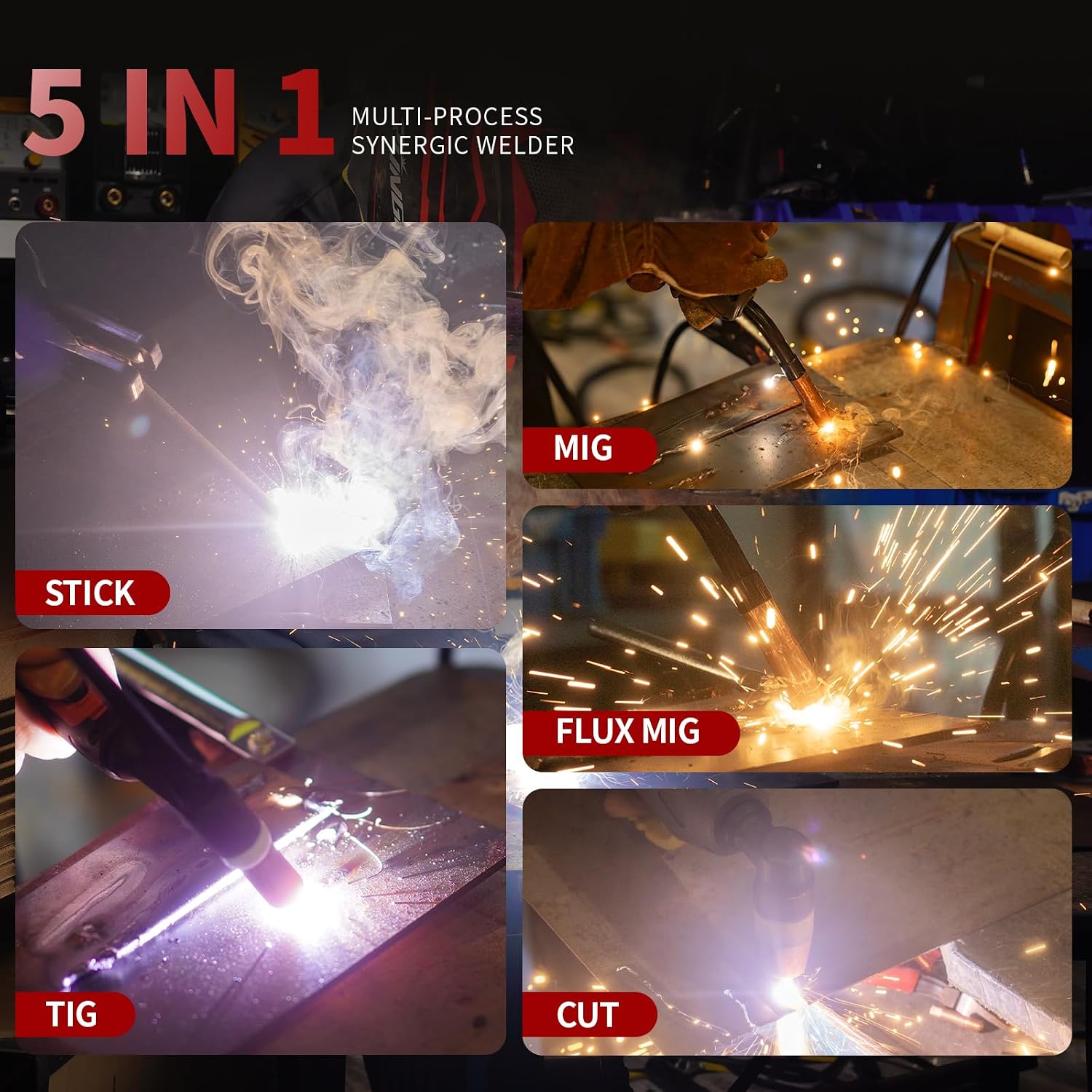
You’ve got one machine bay, one 240-volt outlet, and a job that requires both welding steel and cutting it to shape. A plasma cutter combo machine — a single unit that handles welding (joining metal with an electric arc) and plasma cutting (using a superheated gas stream to slice through metal like scissors through paper) — sounds like the obvious answer. One plug, one price, one footprint. For a lot of shops, that logic holds up. But the word “combo” covers a wide range of machines, and the tradeoffs between convenience and raw performance can catch you off guard mid-project. This guide walks through who these machines are built for, how to read the specs that actually matter, and a clear decision rule for whether you should buy one — or spend the same money on dedicated units instead.
| EDITOR'S PICK[ARCCAPTAIN MIG205MP MIG Welder](https://www.amazon.com/dp/B0B1TGZ8XN?tag=greenflower20-20)… | Mid-tier[TOOLIOM MIG/TIG/CUT/Stick/Flux](https://www.amazon.com/dp/B0CP75HMPY?tag=greenflower20-20)… | Budget pickPlasma Cutter Welder Combo Gas… | |
|---|---|---|---|
| Processes | 9 | 6 | 5 |
| Voltage | 120/240V | 110/220V | 110/220V |
| App Control | ✓ | — | — |
| Pulsed MIG | ✓ | — | — |
| Spool Gun | ✓ | ✓ | — |
| Price | $839.99 | $479.99 | $358.00 |
| See on Amazon → | See on Amazon → | See on Amazon → |
What “Multi-Process with Plasma” Actually Means on a Spec Sheet
The term “multi-process” gets used loosely. At minimum, a true multi-process welder handles MIG (wire-feed welding), TIG (tungsten-electrode welding for precision work), and Stick (the oldest, most portable arc-welding method). Add plasma cutting to that list and you have a four-function machine — sometimes marketed as a “3-in-1” (MIG/Stick/Plasma) or “4-in-1” (MIG/TIG/Stick/Plasma), depending on the manufacturer.
What matters more than the label is how the shared power supply is allocated. Every combo machine runs all four processes off a single inverter (a compact electronic board that converts incoming AC power to the DC or AC output each process needs). That’s fine — inverter technology has matured enough that a well-engineered unit can switch cleanly between processes. The problem shows up in duty cycle: the percentage of a ten-minute window the machine can run at a given amperage before it needs to cool down. A machine rated “200A at 60% duty cycle” can arc at 200 amps for six minutes out of every ten before its thermal protection kicks in and you’re waiting.
Combo machines almost always list separate duty cycle ratings for each process, and those ratings often differ significantly. Per published specs reviewed across Lincoln Electric’s product documentation and Hypertherm’s Powermax operator manuals, the plasma cutting circuit on a combo unit typically runs at a lower duty cycle than a dedicated plasma cutter at the same amperage — because the inverter is designed around the welding load, not optimized purely for cutting. That’s not a flaw; it’s a design choice. But it’s one you need to understand before committing.
The Numbers That Tell the Real Story
By the numbers — typical mid-market combo vs. dedicated plasma at the $1,500–$2,500 price point (2026 market):
| Spec | Mid-Market Combo (e.g., 200A class) | Dedicated Plasma Cutter (e.g., Hypertherm Powermax45 SYNC) |
|---|---|---|
| Plasma duty cycle at rated amps | 35–50% | 50–100% |
| Max clean cut (mild steel) | 3/8 in. typical | 1/2 in. (rated) |
| Severance cut (max possible) | 1/2 in. | 5/8 in. |
| Consumable replacement interval | Shorter (shared arc starts) | Longer (optimized torch geometry) |
Sources: Hypertherm’s Powermax product documentation and aggregated spec comparisons published by Grainger’s industrial catalog listings.
The gap closes at lighter-duty applications. If you’re cutting 1/4-inch plate occasionally between MIG runs on trailer frames, the combo machine’s plasma circuit is more than adequate. If plasma cutting is your primary revenue process — fabricating decorative metalwork by the hour, cutting structural shapes on a production schedule — the duty cycle gap compounds into real downtime over a shift.
When the Combo Machine Is the Right Call
There are four situations where an all-in-one earns its keep, and they’re worth naming explicitly.
1. Space is the binding constraint. A one-car garage shop, a service van, a trailer-mounted mobile rig — when floor space or vehicle payload limits you to one machine, the combo wins by default. Owners in long-run reviews on welding forums consistently report that the footprint advantage alone justifies the performance tradeoffs for mobile fabricators and field-service contractors. The ESAB Rebel series and comparable units in the $1,500–$2,500 range are frequently cited in this context.
2. Plasma cutting is a secondary, low-volume process. If you’re welding 80% of your arc time and cutting maybe 20 minutes per job, you don’t need a production-grade plasma circuit. The combo machine handles tack cuts, notch work, and occasional plate trimming without hesitation. Per ESAB’s published materials on the Rebel EMP series, this is exactly the use case those machines are engineered around.
3. You’re building toward a full process set and cash flow is a factor. A quality combo machine at $1,800–$2,200 lets you cover MIG, Stick, and plasma cutting now, with TIG capability available when you invest in a TIG torch and regulator. That’s a lower entry cost than buying a dedicated MIG, dedicated Stick/TIG inverter, and dedicated plasma cutter separately — even if the dedicated units would outperform the combo at each process individually. The math often favors the combo for shops in their first 12–24 months of building out.
4. Rental, training, and demo environments. Welding schools, community college programs, and shops that rent time to students or small contractors benefit from combo machines because one unit covers all the processes a student or part-time fabricator needs. Fewer machines mean simpler inventory, fewer consumable SKUs to stock, and less maintenance complexity.
When Dedicated Units Are the Better Investment
The combo machine case falls apart in a handful of specific scenarios — and the signals are usually visible before you buy.
Plasma cutting is daily production work. If you’re running a CNC plasma table, cutting architectural metalwork, or doing structural steel prep as your primary revenue activity, the duty cycle of a combo plasma circuit will slow you down within a shift. Hypertherm’s Powermax line — from the Powermax45 SYNC up through the Powermax105 — is built to run in production environments with duty cycles at or near 100% at lower amperages. That’s a fundamentally different machine class than a combo unit’s plasma circuit, and the performance difference shows in cut quality, consumable life, and throughput. Hypertherm’s published cut charts make the sustained-run capability explicit.
You need TIG at production quality. TIG welding (Tungsten Inert Gas, the process used for precision welds on stainless, aluminum, and thin material) is the most sensitive process to power supply stability. Combo machines that include TIG often do so at reduced amperage or with limited AC balance control (AC balance adjusts how much cleaning action versus penetration the arc delivers on aluminum). If TIG is central to your work — aerospace, food-grade fabrication, motorsports — a dedicated TIG inverter from Miller’s Dynasty series or Lincoln’s Aspect series will outperform a combo unit’s TIG circuit significantly, per spec comparisons published in Miller’s product documentation.
You’re buying into a shop with existing infrastructure. If you already have a MIG welder that’s running well, buying a combo machine to add plasma cutting means paying for welding capability you don’t need. In that situation, a standalone plasma cutter — even a mid-market dedicated unit — gives you better plasma performance per dollar than a combo machine’s plasma circuit at a comparable price point.
The job site runs 3-phase power. Most combo machines in the $1,500–$3,000 range are designed for single-phase 240V input. Heavy industrial environments running 3-phase 480V service are better served by dedicated industrial-class equipment from Lincoln or Miller’s heavy-duty lines, where multi-process capability is engineered at a different tier entirely.
Reading the Fine Print: Three Specs That Get Overlooked
Most buyers compare rated amperage and price. These three specs do more predictive work:
Arc starts shared across processes. Every time you strike an arc — welding or cutting — the inverter’s main switching components cycle. Combo machines accumulate arc starts across all four processes. Manufacturers including Miller and Lincoln publish mean-time-between-failure estimates for their inverter boards; combo machines used heavily across all processes will trend toward that maintenance interval faster than a single-process machine used at comparable total arc hours. This matters for total cost of ownership projections over a three-to-five-year ownership horizon.
Plasma torch style and consumable ecosystem. Some combo machines ship with proprietary torches that use unique consumable tips and electrodes available only through the manufacturer’s distribution network. Dedicated plasma cutters — particularly Hypertherm’s Powermax line — run consumables that are widely stocked at Grainger, Airgas, and regional welding distributors, which matters when you need a tip on a Friday afternoon. Before buying a combo machine, confirm that consumables are stocked by at least one distributor in your region.
Input amperage draw at full load. A 200A combo machine drawing 50 amps at 240V when plasma cutting at full output may exceed the breaker capacity of a standard shop panel. Grainger’s industrial electrical guides and Lincoln Electric’s installation documentation both flag this as a common oversight for shops upgrading from lighter equipment. Confirm your panel capacity before the machine ships.
The Decision Rule
Here’s how to cut through the tradeoffs:
If plasma cutting is 25% or less of your monthly arc time, you’re mobile or space-constrained, and your budget is under $2,500 — buy the combo. You’ll cover your core processes, keep your footprint small, and have budget left over for consumables and gas. The ESAB Rebel EMP class and comparable multi-process units in this tier have strong track records in exactly this use case, per aggregated owner reporting and distributor sales data from Grainger’s catalog.
If plasma cutting drives daily revenue, you need full TIG performance, or you’re working in a fixed shop with existing welding equipment — buy dedicated. A dedicated plasma cutter at $1,800–$3,000 (Hypertherm’s Powermax45 or Powermax65 class) will outperform any combo machine’s plasma circuit at that price point in duty cycle, cut quality, and consumable life. Pair it with the dedicated welder you already run, and you’ll have better performance at both processes than any combo machine offers.
The all-in-one machine is a genuinely good solution — for the right shop. The mistake is buying it as a compromise when your actual workflow demands a specialist. Know which half of your work drives the most revenue, spec to that process first, and let the secondary process follow.