You’re already running a welder every day, so you know the helmet on your head isn’t just PPE — it’s your primary interface with the weld puddle. A poor lens (the transparent protective window that darkens automatically when an arc strikes) means you’re reading the puddle through a greenish fog, guessing at bead placement, and ending the day with eye strain. An auto-darkening filter (ADF — a lens that switches from a light shade for normal vision to a dark shade in milliseconds the moment it detects arc light) has replaced the old flip-down passive glass on virtually every professional helmet. But not all ADFs are equal. The three lenses this guide compares — Miller’s ClearLight 2.0, Lincoln Electric’s 4C, and ESAB’s Sentinel technology — are the flagships their respective brands push to professional buyers in the $200–$400 helmet tier. If you have a purchase decision pending, here’s the spec-level breakdown you need.
| EDITOR'S PICK[Lincoln Electric K3034-4 VIKING](https://www.amazon.com/dp/B07V9G94NK?tag=greenflower20-20)… | Mid-tierMiller Digital Performance™ Ser… | Budget pickMiller Classic Series Auto-Dark… | |
|---|---|---|---|
| Lens Technology | 4C Lens Technology | ClearLight 4x Technology | ClearLight Technology |
| Shade Range | — | — | 8-13 |
| Size | Extra Large | — | — |
| Series | VIKING 3350 | Digital Performance | Classic |
| Modes | — | Weld, Grind | — |
| Price | $422.95 | $283.84 | $128.44 |
| See on Amazon → | See on Amazon → | See on Amazon → |
What Actually Separates a “Professional” ADF Lens
Before the brand comparison, it helps to understand the four numbers that define ADF quality — because the marketing language between Miller, Lincoln, and ESAB is different enough to be confusing without a common framework.
Optical clarity class is graded 1/1/1/1 to 3/3/3/3 under the EN 379 European standard, widely adopted by U.S. manufacturers as a quality benchmark. The four digits rate diffusion, angular dependence, luminous transmittance variation, and welding shade variation. A 1/1/1/1 rating is the highest possible — what you’ll find on every helmet in this comparison. According to the American Welding Society Safety and Health Fact Sheet No. 32 on optical clarity in welding helmets, even a second-digit rating of 2 in one category introduces enough distortion to affect puddle reading on precision work like TIG root passes.
Switching speed is how fast the lens goes dark when the arc fires. Measured in fractions of a second (typically 1/25,000 sec on pro helmets), a slow switch exposes your retinas to unfiltered arc flash. All three helmets here meet or beat 1/25,000 sec in arc-detection speed — so this is not a meaningful differentiator at the pro tier.
Shade range determines the darkening level the lens can hit, measured on a scale where higher numbers mean less light transmission. Most TIG work runs shade 9–11; heavy MIG and stick can push to shade 13. Pro helmets typically cover shade 5–13 on the variable range.
True color rendering — the marketing battleground between these three — is about what the weld pool looks like chromatically. Standard ADF lenses have historically cast a greenish or yellowish tint. All three brands now claim near-neutral color rendering. The differences are real but subtle; the sections below get into specifics.
Head-to-Head: Three Lenses, Three Use Cases
Miller Digital Elite — ClearLight 2.0 Lens
Miller’s ClearLight 2.0 lens, currently shipping in the Digital Elite and Dynasty-series helmets, is built around a multi-layer filter stack. According to Miller Electric ClearLight 2.0 Lens Technology product documentation published on millerwelds.com, the design targets a neutral color temperature — meaning the weld pool should appear white-to-gray rather than tinted. The published optical class is 1/1/1/1 under EN 379.
Operators doing precision TIG work on stainless and aluminum consistently report, across aggregated coverage at Popular Mechanics (Best Welding Helmets Reviewed) and community discussion at WeldingWeb, that puddle edges read cleaner and eye fatigue is lower on 4–6 hour shifts. The reason on paper: Miller’s current-generation lens uses four arc sensors positioned at the corners of the viewing area, reducing the chance that a torch hand or workpiece shadow blocks arc detection. The Digital Elite’s viewing area measures 3.93 × 2.36 inches — competitive but not the widest in this comparison.
Honest tradeoffs: ClearLight 2.0 helmets run approximately $250–$380 at distributor pricing per Grainger’s 2025–2026 catalog tiers, placing them mid-to-high for the professional segment. Miller’s flagship helmets run on solar-assist plus replaceable batteries; when the battery degrades (typically after 2–3 years of heavy shop use), the lens can begin flickering before the failure is obvious. Replacement is straightforward, but operators need to track the maintenance cycle.
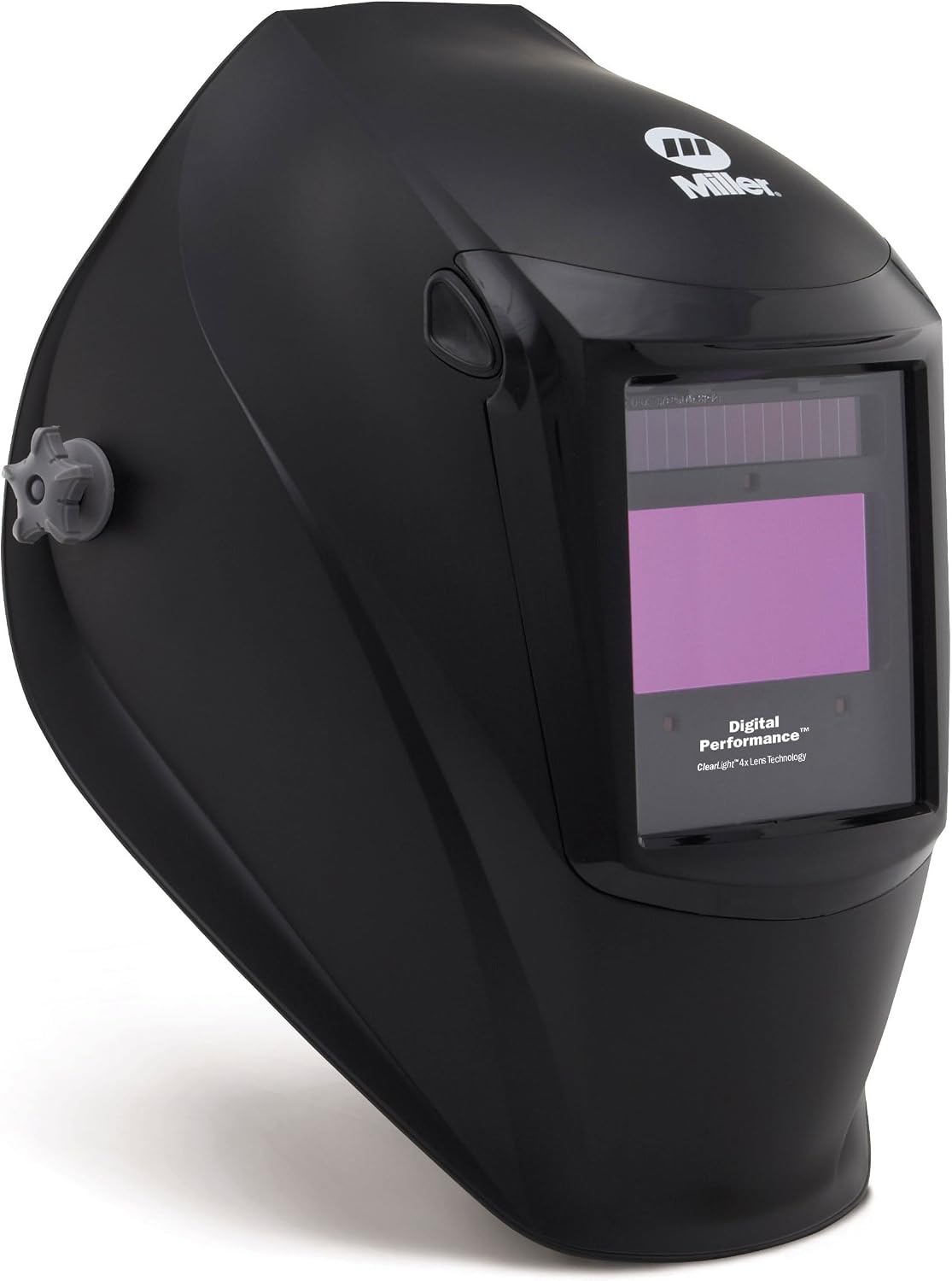
Miller
$283.84
In stock on Amazon
Check price on AmazonLincoln Electric VIKING 3350 — 4C Lens
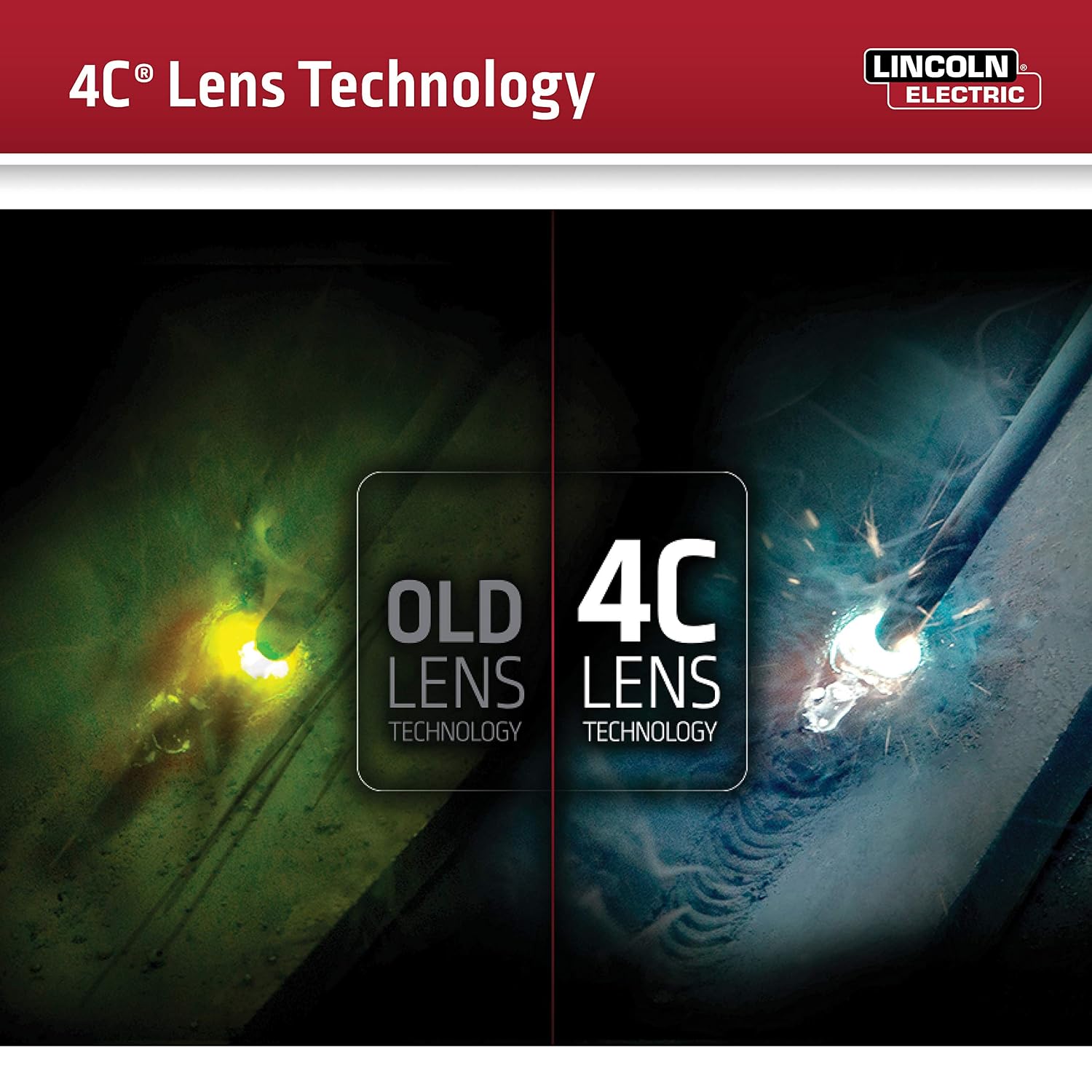
Lincoln’s 4C lens — marketed as “4 Color” technology — ships in the VIKING 3350 and VIKING 4C series helmets. Per the Lincoln Electric VIKING 3350 4C Lens Series specification sheet published on lincolnelectric.com, the 4C lens targets color rendering across all four visible color bands simultaneously, rather than prioritizing the yellow-green band that older ADF technology was biased toward. Published optical class: 1/1/1/1.
The VIKING 3350’s standout specification is its viewing area: 3.82 × 3.15 inches, the widest in this comparison by a meaningful margin. For flux-core production welders, structural fabricators working in overhead positions, or anyone doing multi-pass fillet welds where repositioning is constant, that extra vertical viewing real estate reduces neck movement and cumulative fatigue across a shift. Popular Mechanics’ Best Welding Helmets Reviewed coverage has identified the VIKING’s field of view as a best-in-class differentiator in the professional segment.
The VIKING 3350 covers shade 5–13 with a grind mode accessible via an external button — a practical feature on production floors where operators move between welding and angle grinding without pausing to navigate menu settings.
Honest tradeoffs: Operators doing critical TIG work on stainless describe a slightly warmer — more amber — rendering compared to Miller’s neutral-white output. Neither interpretation is objectively wrong, but TIG precision welders notice the difference. The VIKING 3350 also weighs approximately 1.73 lbs per Lincoln Electric’s specification sheet, making it the heaviest option in this comparison; over a full shift, helmet weight compounds neck strain in ways that accumulate across a career. Street price in 2026 runs approximately $230–$310 at major distributors per Grainger catalog tiers — the most accessible of the three on upfront cost.
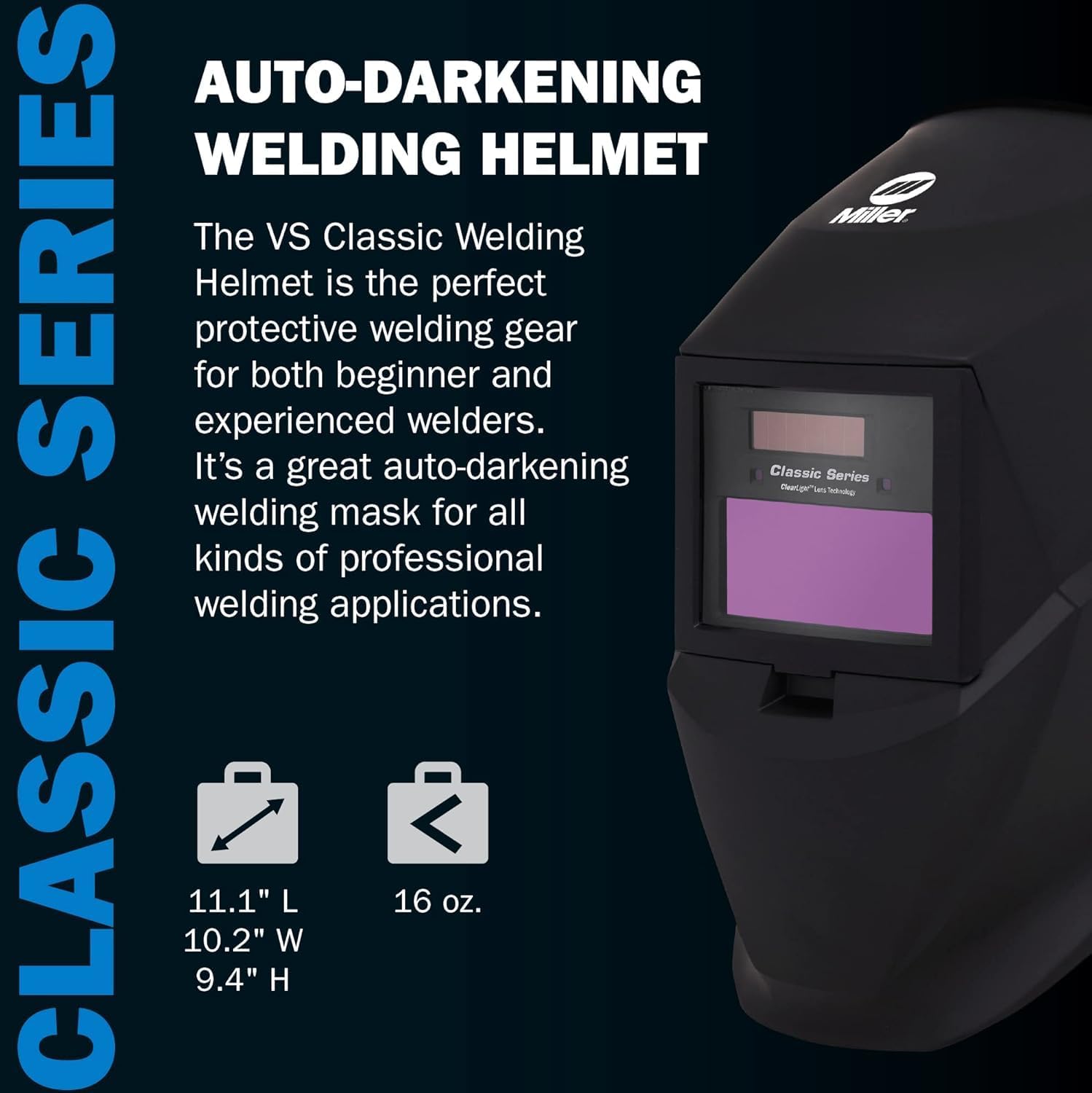
Miller
$128.44
In stock on Amazon
Check price on AmazonESAB Sentinel A60 — Curved Panoramic Lens
ESAB’s Sentinel A60 takes a different product philosophy than Miller or Lincoln. According to the ESAB Sentinel A60 auto-darkening helmet product page on esabna.com, the helmet leads with its curved outer shell design — engineered to clear tight spaces and reduce snag points on structural work — and a panoramic 3.94 × 2.87-inch curved viewing lens that wraps the peripheral field of view rather than sitting flat against the face.
The ADF is rated 1/1/1/1 optical class with a shade range of 5–13. What differentiates the Sentinel optically is the curved lens geometry: by matching the lens curvature to the eye’s natural focal plane, ESAB claims reduced distortion at the edges of the viewing area. Operators in longer-form evaluations, including coverage at Popular Mechanics, consistently note that the Sentinel’s peripheral clarity — how the image reads at the far left and right edges of the lens — is noticeably better than flat-lens alternatives at this price tier.
The Sentinel A60 ships with an external touchscreen-style control panel on the front of the shell for shade adjustment, grind mode, and sensitivity settings, accessible without removing the helmet. For welders who switch between processes mid-shift — say, TIG root passes at shade 10 followed by flux-core fill at shade 12 — this is a genuine workflow advantage. The Sentinel A60 runs solar-assist plus a lithium battery; per ESAB consumables documentation on esabna.com, the lithium design offers longer shelf life than coin-cell alternatives, though replacement requires an ESAB-specific part rather than a standard hardware-store battery.
Honest tradeoffs: At approximately $300–$400 street price per Grainger 2025–2026 distributor catalog tiers, the Sentinel A60 is the highest-priced option in this comparison. The curved shell, while a genuine ergonomic advantage in confined spaces, means replacement outer lenses are Sentinel-specific and carry a higher per-unit cost than generic flat replacements, per ESAB’s consumables documentation.
Lincoln
$422.95
In stock on Amazon
Check price on AmazonBy the Numbers
| Specification | Miller Digital Elite (ClearLight 2.0) | Lincoln VIKING 3350 (4C) | ESAB Sentinel A60 |
|---|---|---|---|
| Optical Class | 1/1/1/1 | 1/1/1/1 | 1/1/1/1 |
| Viewing Area | 3.93 × 2.36 in | 3.82 × 3.15 in | 3.94 × 2.87 in (curved) |
| Shade Range | 5–13 | 5–13 | 5–13 |
| Approx. Street Price (2026) | $250–$380 | $230–$310 | $300–$400 |
| Arc Sensors | 4 | 4 | 4 |
| Weight | Not specified in documentation | ~1.73 lbs | Not specified in documentation |
Sources: Miller Electric ClearLight 2.0 product documentation (millerwelds.com); Lincoln Electric VIKING 3350 4C Lens specification sheet (lincolnelectric.com); ESAB Sentinel A60 product page (esabna.com); Grainger 2025–2026 distributor catalog tiers.
The Decision Rule: If X, Then Y
The honest frame for where you probably are:
If your primary work is precision TIG — stainless, aluminum, critical root passes — and color accuracy directly affects your quality output: The Miller Digital Elite with ClearLight 2.0 is the pick. The neutral color rendering and four-sensor detection are built for exactly this application, and the operator feedback pattern documented in Popular Mechanics’ Best Welding Helmets Reviewed and WeldingWeb community evaluations consistently points this direction.
If you run multi-process production work — MIG, flux-core, stick in rotation — and you care more about field of view and value per dollar: The Lincoln VIKING 3350 wins on the merits. The widest viewing area in the comparison, the lowest entry price, and proven multi-process handling make it the default for production environments where TIG precision work is not the daily priority.
If you work in varied environments — structural, field work, confined spaces — or you switch processes frequently in the same shift and want ergonomic comfort over a long career: The ESAB Sentinel A60 justifies its premium. The curved peripheral lens, the external control panel, and the shell geometry are documented engineering differences, not marketing. Budget for Sentinel-specific consumables and factor the lithium battery replacement into your maintenance schedule.
One note that applies across all three: optical class 1/1/1/1 is the baseline for professional work, and all three helmets meet it. If you are currently running a helmet with a 1/1/2/1 or lower rating — common on $80–$120 budget helmets — the upgrade to any of these three will be immediately noticeable in puddle readability and end-of-day eye fatigue. The American Welding Society Safety and Health Fact Sheet No. 32 on optical clarity in welding helmets makes clear that optical distortion at the lens level compounds over long arc-on sessions in ways welders often attribute to other causes. At $230–$400 per unit, every option in this comparison costs less than a single rejected weld on a certified structural job — making the helmet one of the highest-ROI upgrades available to a working professional.