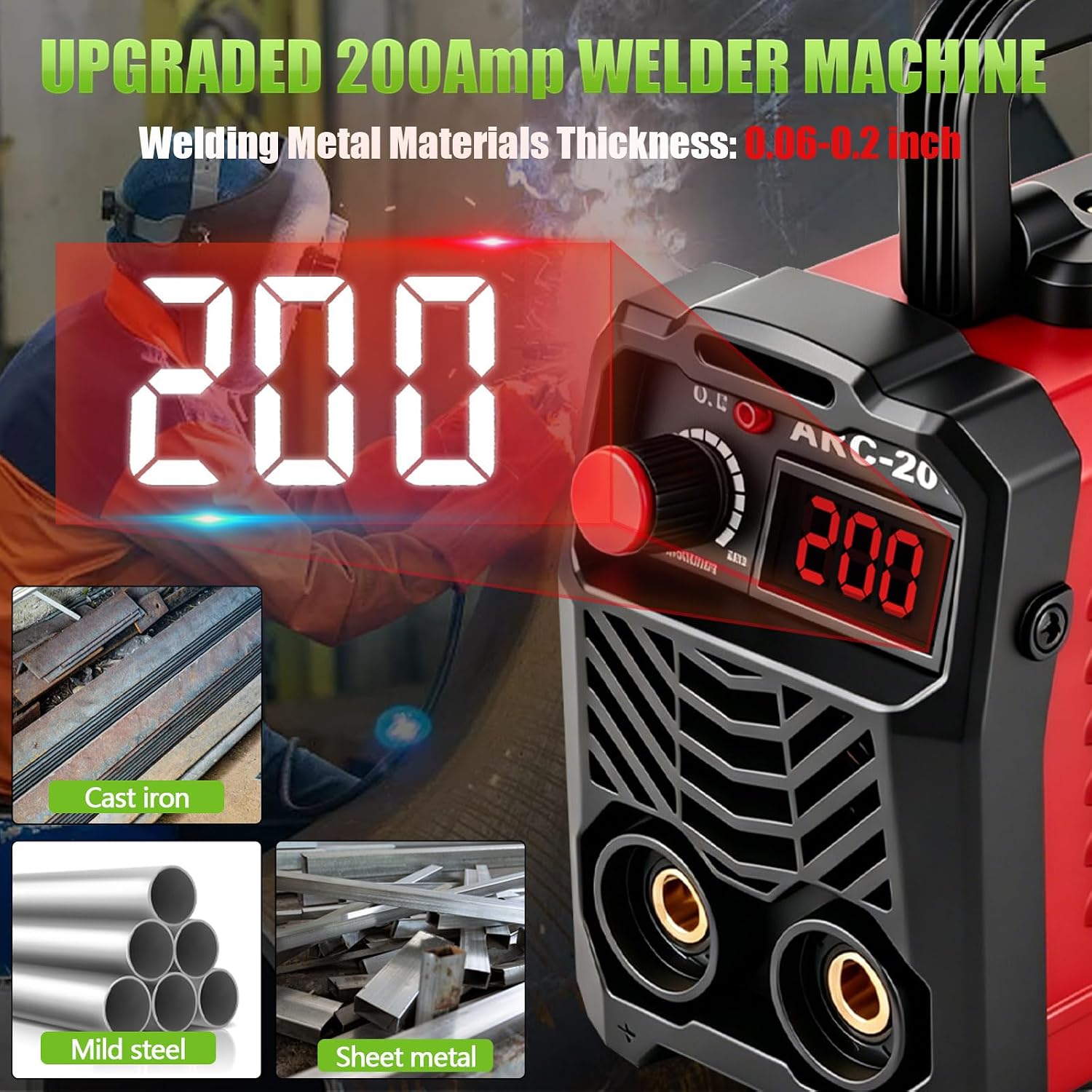
Stick welders have been around since the early 1900s, and the core process — striking an arc between a coated electrode (a “stick,” also called a SMAW electrode, short for Shielded Metal Arc Welding) and a base metal to fuse them together — hasn’t changed much. What has changed is how machines are rated, how they’re regulated for safety in hazardous environments, and how aggressively marketing leans on a single number — peak amperage — to sell units that may not hold up to the actual demands of your day. If you’re buying a stick welder to run production in a shop, to haul onto a jobsite, or to certify work on structural or pipeline contracts, the headline amp number tells you surprisingly little. Two specs that get buried in the datasheet — duty cycle and VRD (Voltage Reduction Device) — will define whether the machine earns its keep or becomes a bottleneck. This guide breaks down what those specs mean in practice, how to read them honestly, and which decision path makes sense for your situation.
What Duty Cycle Actually Means — and Why the Nameplate Lies
Duty cycle is defined by the American Welding Society (per the AWS ANSI/AWS A3.0 Standard Welding Terms and Definitions) as the percentage of a ten-minute period during which a welder can operate at a rated output before it must cool down to prevent thermal damage. A machine rated at 300A / 60% duty cycle can run at 300 amps for six minutes, then needs four minutes of rest before the next sustained arc.
That sounds clean on paper. In practice, it gets messier for two reasons.
First, temperature matters. Nameplate duty cycle ratings are almost universally tested at 40°C (104°F) ambient temperature — per testing standards referenced in Lincoln Electric’s published duty cycle documentation. Working in a hot shop or under summer sun in the Southeast? Ambient temps above 40°C derate a machine’s real-world duty cycle meaningfully. A unit rated 60% at 40°C might behave more like a 40–45% machine at 50°C. Manufacturers including Miller Electric note this derating effect in their application guidance, though it rarely makes it onto the spec sticker.
Second, most marketing amps are peak amps, not duty-cycle amps. A machine advertised as “250A” may only be rated at 250A at a 20% or 35% duty cycle. The 60% or 100% rating — the numbers that matter for sustained production work — might be 180A or 200A. ESAB’s stick welder selection documentation specifically flags this distinction, noting that continuous-production buyers should compare units at 60% or 100% duty cycle ratings rather than peak output.
The Math That Changes Your Decision
Here’s a simplified way to think about arc-on time on a real job:
By the Numbers
| Scenario | Arc-on % per hour | Minutes of actual welding |
|---|---|---|
| Field repair (fit-up heavy) | ~25–35% | 15–21 min |
| Shop production (groove welds) | ~45–60% | 27–36 min |
| Continuous wire-out pipeline pass | ~65–80% | 39–48 min |
If your work is field repair — you spend half your time fitting, grinding, and repositioning — a 35% duty cycle machine at full rated amps may never thermal-trip on you. But a production shop running back-to-back groove passes needs a machine rated at 60%+ at the actual amperage you’re running, or you’re building rest cycles into your production schedule involuntarily.
The practical rule: identify the amps you’ll run most (not max), find the duty cycle at that specific amperage, then compare that to your realistic arc-on percentage. That number is your real spec.
VRD: The Safety Feature That Also Affects Arc Feel
VRD stands for Voltage Reduction Device, and if you haven’t had to think about it yet, you will once you’re working on construction sites governed by Australian, EU, or increasingly U.S. municipal safety codes — or any environment where the risk of electric shock is elevated: confined spaces, wet or damp conditions, scaffolding, or working in close contact with the workpiece.
Here’s the basic problem: SMAW machines require an open-circuit voltage (OCV) — the voltage present at the electrode tip before the arc is struck — of typically 50–80V to reliably ignite and maintain an arc. That voltage is present the moment you’re between passes, repositioning, or accidentally touching the electrode to a grounded surface. For a healthy adult in a dry environment, 50–80V is uncomfortable but survivable. In a confined space, on wet steel, or for a fatigued worker in full contact with a conductive workpiece, it can be fatal. Miller Electric’s safety guidance cites this as one of the primary electrical hazard scenarios in field SMAW work.
A VRD reduces the electrode’s open-circuit voltage to a safe threshold — typically under 35V or even under 15V depending on the standard — and then rapidly ramps the voltage back up the instant a strike is detected, allowing normal arc initiation. The worker is protected during the “between-passes” window when contact risk is highest.
The tradeoff that practitioners debate: VRD systems add a small detection delay, and some electrodes — particularly low-hydrogen rods like E7018, which already demand a precise strike — can feel slightly harder to start reliably with VRD active. This is a real effect, not marketing fiction; operators on WeldingWeb forums and in Lincoln Electric’s published application notes both acknowledge it. In practice, experienced welders adapt their strike technique (drag start vs. scratch start) and the impact becomes negligible. But if you’re evaluating a machine and planning to hand it to a less experienced crew, test-arc initiation behavior on E7018 specifically.
Not every machine has VRD as standard. Many add it as an optional switchable feature. Some higher-end inverters — including units in Lincoln Electric’s Flextec line and Miller’s XMT series — offer VRD that can be toggled on or off depending on the job environment, which is the right approach for a shop that moves between controlled and field environments.
Decision rule on VRD: If any portion of your work involves confined spaces, offshore, structural jobsites with site-safety requirements, or OSHA-adjacent contractor compliance, get a machine with VRD — switchable preferred, mandatory where the work demands it. Don’t treat it as optional on those jobs. For a dedicated dry-shop machine that never leaves the building, VRD is less critical but still good practice.
Matching Machine Type to Your Real Environment
With duty cycle and VRD framed, here’s how those specs interact with machine category:
Transformer-Based Machines
The old iron-core stick welders — think Lincoln’s Idealarc family or older Miller Dialarc units — are transformer-based. They’re heavy, robust, and nearly indestructible under sustained load. Duty cycle is generally very high (often 100% at rated amps) because the thermal mass of the transformer absorbs heat well. They have no electronics to fail in harsh environments, and cost of ownership over 20 years is genuinely low.
What they don’t offer: portability, fine arc control, inverter-level efficiency, or VRD compatibility in older units. For a permanent shop installation running heavy structural production, they’re still a defensible choice. For field work? The weight eliminates them from serious consideration for most crews.
Inverter-Based Machines
Inverter technology replaced the 60Hz transformer with a high-frequency conversion circuit, shrinking size and weight dramatically while improving arc characteristics and efficiency. Machines like the Lincoln Electric Flextec 350X, Miller Electric XMT 350 FieldPro, or ESAB Rogue ES 180i cover a range of production needs with inverter cores.
The tradeoff: electronics are more sensitive to dust, moisture, and physical shock than a transformer core. Grainger’s industrial supply listings note IP (Ingress Protection) ratings vary significantly between inverter units designed for shop use versus field deployment — check for IP23S or better for jobsite machines. Inverters also derate more aggressively in extreme heat, which loops back to the duty cycle discussion above.
Inverters are almost universally the right call for field crews and for shops that value arc quality and control. The key is buying the right IP-rated, VRD-equipped inverter rather than grabbing the cheapest unit with the biggest headline amp number.
Multi-Process Machines with Stick Mode
If your shop runs TIG, MIG, and stick work — or if you’re a contractor who needs one machine to do multiple jobs — multi-process inverters (ESAB Rebel EMP 235ic, Lincoln Power MIG 260, and up the range to the Miller Multimatic 255) include SMAW mode. The stick performance on a well-designed multi-process machine is generally excellent. The tradeoff is price and, sometimes, duty cycle at high SMAW amps — multi-process machines prioritize wire-feed duty cycles; verify the SMAW-specific duty cycle rating separately on the spec sheet, not the headline figure.
The Decision Frame: If X, Then Y
After the specs are in order, the decision usually resolves to one of these paths:
If you’re running production stick in a controlled shop environment at sustained amperage above 200A: Prioritize duty cycle at your actual working amps (60%+ at 200A minimum), verify ambient derating, and consider a transformer-based machine if portability isn’t a factor. Machines in the Lincoln Electric Flextec or Miller XMT tier handle this well; expect to spend $2,500–$5,000+.
If you’re taking the machine to jobsites, confined spaces, or mixed-environment contracts: Inverter only, IP23S or better, VRD switchable, weight under 25 lbs preferred for solo carry. Budget $1,500–$3,500 for a professional-grade unit. Skimping on IP rating here is how you explain a field repair to a site safety officer.
If you’re running occasional stick work alongside TIG or MIG in a shop: A multi-process inverter handles it cleanly. Verify the SMAW duty cycle spec — don’t accept the MIG duty cycle as a proxy. Per ESAB’s selection documentation, SMAW and MIG ratings on the same machine can differ by 20 percentage points at comparable amps.
If peak amperage is the primary selling point and duty cycle is buried or vague: Walk away, or dig until you find the duty cycle at 60% — not at 20% or 35%. That number is the honest one.
Peak amps sell machines. Duty cycle and VRD keep workers safe, keep production moving, and keep warranty claims off your desk. The welder who’s done this long enough has usually learned that lesson once the hard way. You don’t have to.