You’ve upgraded your wire feed, dialed in your shielding gas mix, and you’re still fighting inconsistent fusion on thin stainless. Before you chase another parameter, look at what’s sitting in front of your eyes. The lens in your auto-darkening welding helmet — the filter that snaps dark the instant you strike an arc — carries a four-number optical clarity rating stamped somewhere on the shell or packaging. Most welders glance at it once and forget it. That’s a mistake, because those four numbers directly influence how accurately you can track a weld puddle, how fatigued your eyes get over a long shift, and ultimately whether your bead placement is as precise as your skill level actually allows. This guide breaks down exactly what each number means, shows you the real-world difference between a 1/1/1/1 (highest-grade) lens and a more common 1/1/1/2 lens, and gives you a clear decision rule for which rating your work actually warrants.
| EDITOR'S PICK[Lincoln Electric K3034-4 VIKING…](https://www.amazon.com/dp/B07V9G94NK?tag=greenflower20-20) | Mid-tier[YESWELDER Large View Auto Darke…](https://www.amazon.com/dp/B07M5WKCYX?tag=greenflower20-20) | Budget pick[YESWELDER Auto Darkening Weldin…](https://www.amazon.com/dp/B07QJ1Y527?tag=greenflower20-20) | |
|---|---|---|---|
| Lens Rating | — | 1/1/1/1 | 1/1/1/1 |
| Arc Sensors | — | 4 | 2 |
| Shade Range | — | 3/5-9/9-13 | 3.5/9-13 |
| View Size | Extra large | Large | — |
| Power Source | — | Solar | Solar |
| Price | $422.95 | $49.99 | $33.99 |
| See on Amazon → | See on Amazon → | See on Amazon → |
What the Four Numbers Actually Mean
The rating system comes from European standard EN ISO 16321, which governs eye and face protection for occupational use. Even helmets sold in North America — which must also meet requirements under American National Standards Institute ANSI Z87.1-2020 — are increasingly rated under the EN ISO scale because it gives buyers a more granular picture of optical quality than older pass/fail tests.
Each of the four numbers rates a different dimension of how well the lens lets you see, on a scale of 1 (best) to 3 (acceptable minimum for welding use). Think of them as four separate report-card grades:
1. Optical Class (first digit) — This is the big one. It measures overall distortion: how much does the lens bend or warp straight lines? A class 1 lens introduces virtually no distortion. A class 2 lens introduces slight distortion — enough to make a straight edge look faintly curved when viewed at an angle. A class 3 lens has noticeable distortion.
2. Diffusion of Light (second digit) — Rates how much the lens scatters light passing through it. Scatter creates a hazy, lower-contrast image. A rating of 1 means the lens transmits a clean, sharp image. A 2 adds mild haze.
3. Variations in Luminous Transmittance (third digit) — Measures consistency of tint across the entire lens surface. A 1 means the shade is uniform from edge to edge. A 2 means the shade varies slightly — typically darker at the edges and lighter near center, or vice versa.
4. Angle Dependence of Luminous Transmittance (fourth digit) — Rates how much the shade level shifts when you view through the lens at an angle rather than head-on. A rating of 1 means minimal shift. A 2 means the lens gets noticeably lighter or darker as your viewing angle changes — which matters every time you shift your body position relative to the joint.
So a 1/1/1/1 lens earns the top grade on all four counts. A 1/1/1/2 lens — the most common rating in the mid-price helmet range — scores top marks on the first three dimensions but steps down on angle-dependent shade consistency.
How the Ratings Stack Up: A Tier-by-Tier Comparison
Understanding the rating scale in the abstract is useful. Seeing how it maps to real helmet tiers and real work scenarios is where the decision becomes actionable. The three sections below break the market into budget, mid-tier, and premium categories, each tied to specific optical performance characteristics.
Budget Tier: 1/1/2/2 and Below
Helmets in this category typically carry a 1/1/2/2 optical rating or lower and retail in the range of $50–$130. The first two digits — optical distortion and light scatter — still score at the top level, which means straight lines look straight and you’re not fighting visible haze. But shade uniformity (third digit) and angle consistency (fourth digit) both step down to a “2,” meaning the tint can vary somewhat across the lens surface and will shift more noticeably as your viewing angle changes.
For a welder doing occasional repair work, hobby fabrication, or short tack sessions on non-critical material, these limitations rarely cause practical problems. Flat-position work at a comfortable angle minimizes the angle-dependence penalty almost entirely. The budget tier becomes a liability primarily when work demands extended arc-on time or out-of-position technique, because the compounding effects of uneven shade and angle-shift become fatiguing faster than most buyers anticipate.
If budget is the primary constraint and the work is light-duty, a 1/1/2/2 helmet from an established brand is a reasonable starting point — but treat it as a stepping stone, not a permanent tool.
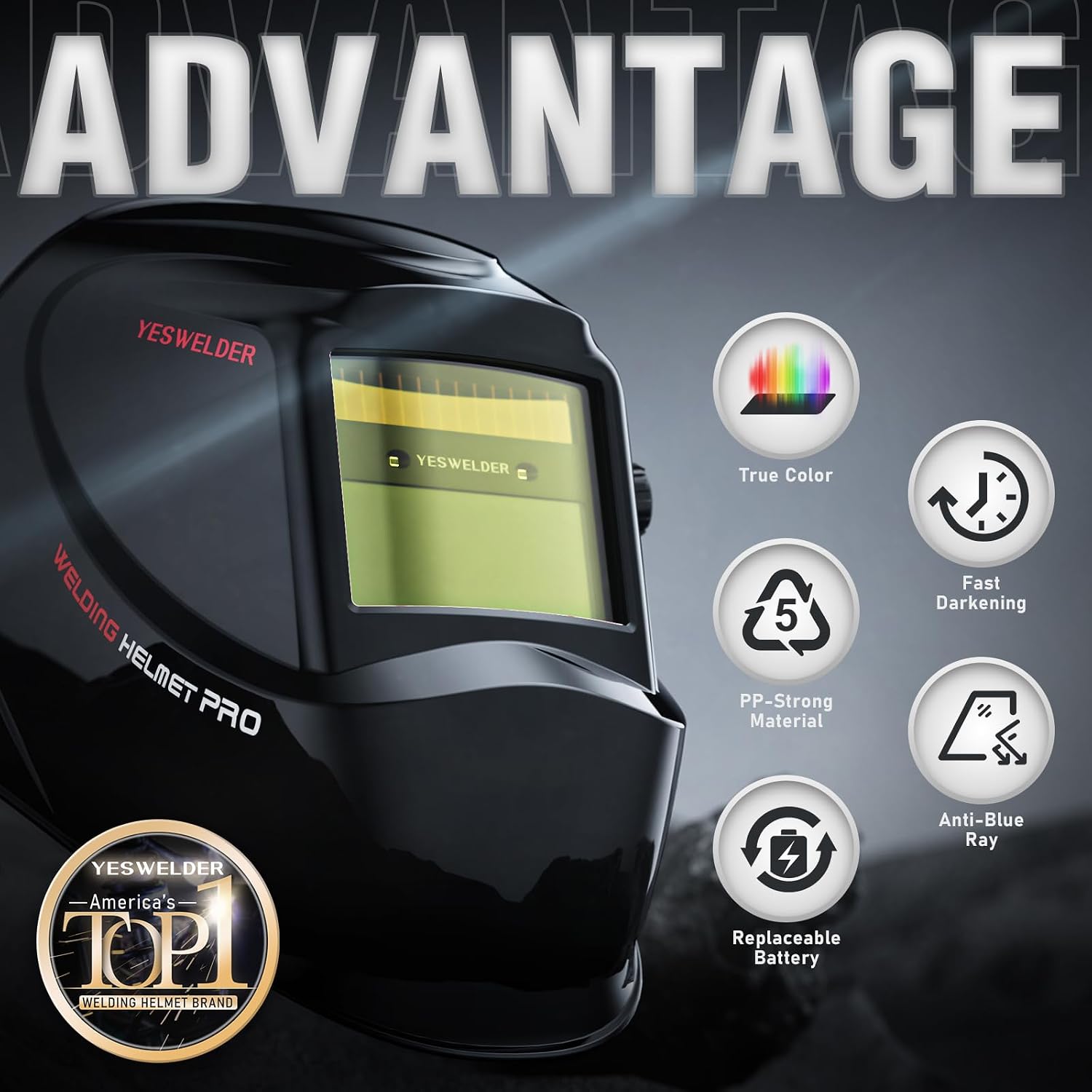
YESWELDER
$33.99
In stock on Amazon
Check price on AmazonMid-Tier: 1/1/1/2 — The Most Common Production Choice
The 1/1/1/2 rating is where the bulk of the market sits for working professionals who aren’t doing precision TIG or constant out-of-position certified welds. Helmets in this category typically retail between $130 and $350. The Lincoln Electric Viking series and the Miller Electric Digital Elite both land in this optical class based on published specifications available in Lincoln Electric’s Welding Helmet Buying Guide on lincolnelectric.com and in Miller Electric’s Auto-Darkening Helmet Technology Overview on millerwelds.com.
At 1/1/1/2, you’re getting excellent marks on distortion, scatter, and shade uniformity. The trade-off is angle dependence. As Miller Electric’s helmet documentation explains, the lens will shift shade somewhat as viewing angle moves off-axis — a characteristic that rarely surfaces during flat or horizontal passes but becomes noticeable during overhead work, vertical-up runs, and 5G or 6G pipe positions where your head angle relative to the joint changes continuously.
For a production shop running flat-plate MIG or flux-core in fixed positions, the 1/1/1/2 rating represents a genuine sweet spot: three out of four optical dimensions at maximum score, at a price point that makes outfitting a crew feasible. Lincoln Electric’s Welding Helmet Buying Guide notes that for flat-position production environments, the 1/1/1/2 class delivers performance that exceeds most operators’ perceptual threshold under normal arc-on conditions.
The fatigue argument deserves attention here. Miller Electric’s Auto-Darkening Helmet Technology Overview explains that suboptimal optical performance — even the subtle angle-dependent shift of a “2” on the fourth digit — contributes to accelerated eye fatigue over a full shift. The mechanism is that your visual system continuously compensates for inconsistencies even when you’re not consciously aware of them. Welders who move from a 1/1/1/2 to a 1/1/1/1 lens often report the difference feels minor during the first hour but significant by hour six or seven.
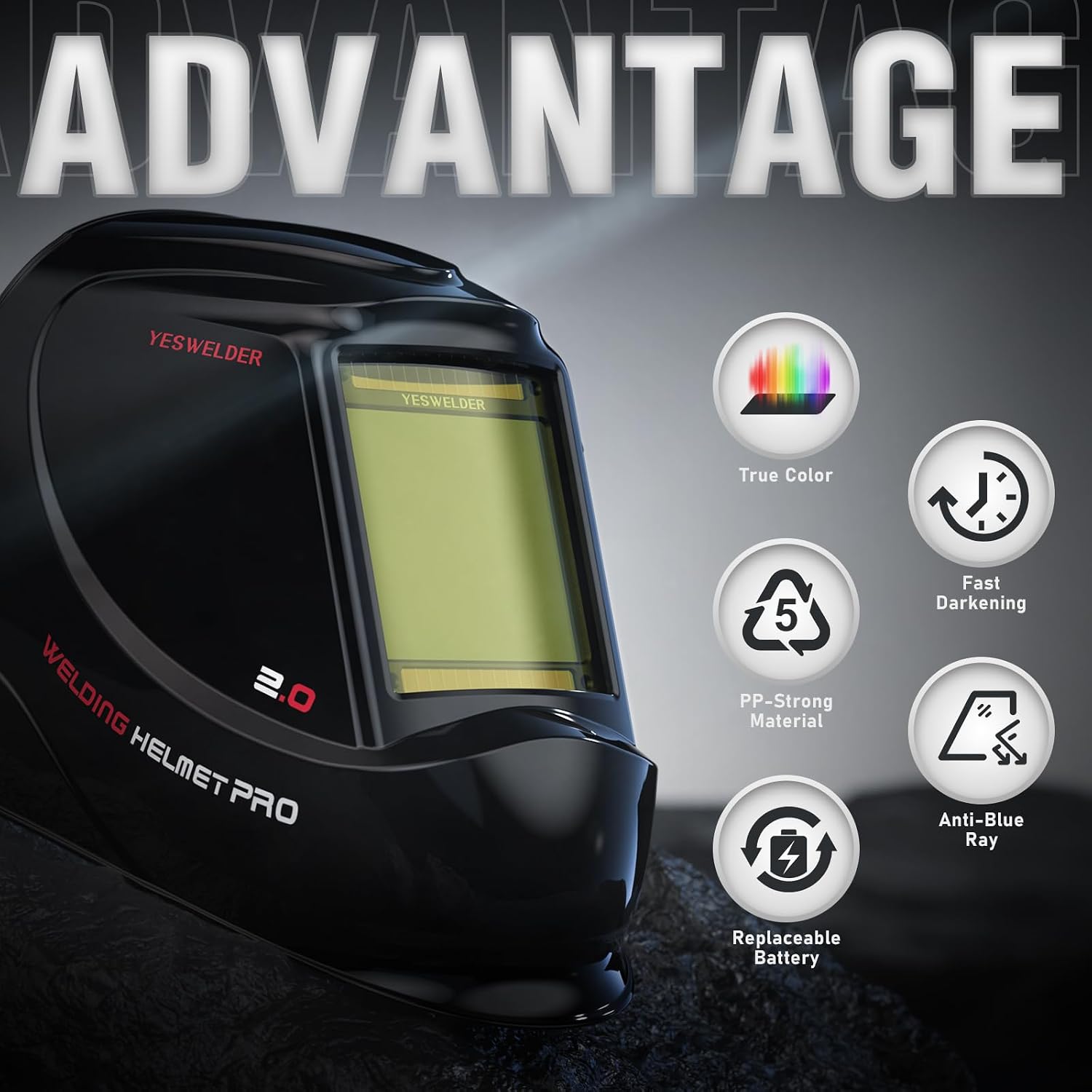
YESWELDER
$49.99
In stock on Amazon
Check price on AmazonPremium Tier: 1/1/1/1 — When Every Digit Matters
A 1/1/1/1 lens scores at the top level on all four optical dimensions. Helmets carrying this rating typically start around $250 and extend well past $500 for professional-grade models. The ESAB Sentinel A50, the Miller Electric T94i, and the 3M Speedglas 9100X series are commonly cited examples in this tier based on published specifications from their respective manufacturers.
The case for 1/1/1/1 is strongest in three specific situations. First, precision TIG welding on thin stainless, aluminum, or reactive alloys — where puddle-reading is the primary skill and any optical degradation translates directly to imprecise bead placement and inconsistent fusion. Second, out-of-position certified structural or pipe welds, where the angle-dependence penalty of a “2” on the fourth digit compounds with the physical difficulty of maintaining position and hitting procedure specifications at the same time. Third, long shift durations of six hours or more of arc-on time, where the fatigue reduction from eliminating all four sources of optical compromise pays dividends in consistency during the final hours of the day.
ESAB’s Choosing the Right Welding Helmet guide, published on esabna.com, explicitly identifies 1/1/1/1 optical class as the appropriate specification for welders who work extensively out-of-position or in precision TIG applications where puddle visibility is the controlling factor in weld quality.
Lincoln Electric’s Welding Helmet Buying Guide also recommends 1/1/1/1 lenses for training environments on the grounds that beginners benefit from every perceptual advantage available — a clear, distortion-free view tightens the learning feedback loop in ways that matter most when a new welder is still developing the ability to read a puddle under imperfect conditions.
The ANSI Z87.1-2020 standard, administered by the American National Standards Institute, requires that auto-darkening lenses perform adequately in both the light state and the dark state. EN ISO 16321 similarly evaluates both states. When evaluating any premium helmet, confirm that the 1/1/1/1 rating applies to the dark state specifically — that is the state in which you are actually welding, and some manufacturers rate only the lighter pilot state. The dark-state rating is the one that governs your actual welding experience.
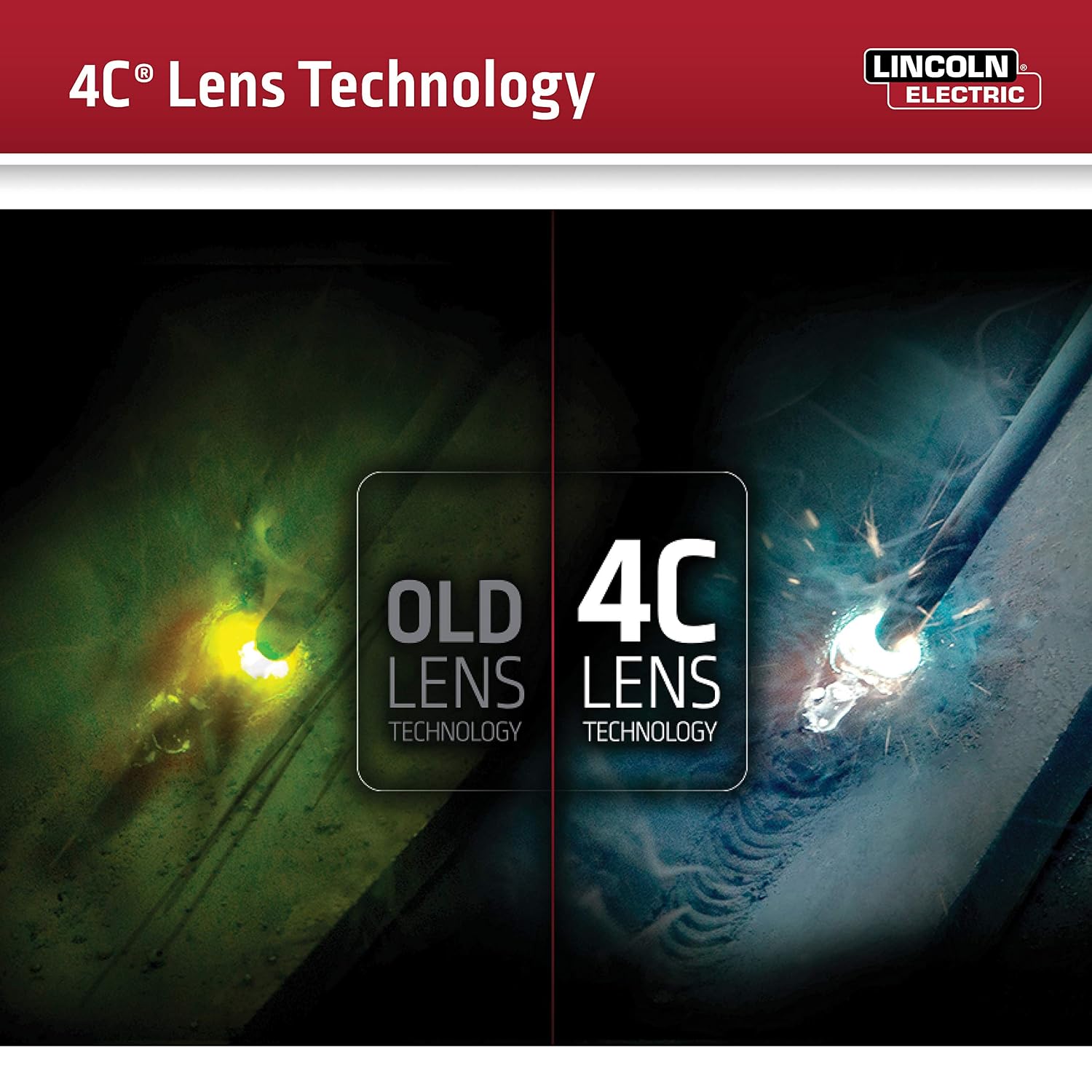
Lincoln
$422.95
In stock on Amazon
Check price on AmazonHow to Find and Verify the Rating Before You Buy
Manufacturers are not always consistent about where they print the optical rating. Here’s where to look:
- On the lens cartridge itself — Many auto-darkening filter (ADF) cartridges have the rating etched or printed on the frame of the cartridge, visible when the helmet shell is flipped open.
- On the inside of the helmet shell — Sometimes printed near the headgear adjustment mechanism or along the inner edge of the viewing window cutout.
- In the product specification table — Miller Electric and Lincoln Electric both list optical class prominently in the specification tables on their respective product pages at millerwelds.com and lincolnelectric.com.
- On the outer packaging — Premium helmets in the 1/1/1/1 class call out the rating explicitly on the box because it is a competitive differentiator. If a helmet’s packaging does not show the rating, that absence is itself informative.
One practical rule: if you cannot find the optical rating anywhere on the helmet, its documentation, or its manufacturer’s product page, assume you are looking at a 1/1/1/2 at best. Manufacturers who achieve a 1/1/1/1 rating have strong commercial incentive to say so clearly. Silence on the subject rarely signals good news.
Also confirm whether the stated rating covers both the light state and the dark state. EN ISO 16321 evaluates both, and ANSI Z87.1-2020 requires adequate performance in both — but some manufacturers specify only the dark state and others only the light state. The dark state is the one that governs what you see while the arc is running.
The Decision Rule
Here’s the if/then framework, calibrated to real production situations:
If your work is predominantly out-of-position — overhead, vertical, 5G or 6G pipe — or precision TIG on thin material, or certified structural welds with strict procedure compliance requirements, then a 1/1/1/1 lens is the correct specification. Budget $250 or more for a helmet from a manufacturer whose optical rating is independently verifiable under EN ISO 16321.
If your work is primarily flat or horizontal MIG or flux-core production, hobby fabrication, or budget-constrained shop outfitting for non-critical welds, then a 1/1/1/2 lens from a reputable brand is a rational choice. You are not leaving significant performance on the table for that work pattern, and the cost savings are real and substantial at scale.
If your work is occasional and non-critical — weekend fabrication, light repair, short tack sessions — a 1/1/2/2 helmet from an established brand covers the minimum functional requirement without unnecessary expenditure.
In all three cases, find the number before you buy. The arc doesn’t care what rating is on your helmet. But the quality of your weld, and the condition of your eyes at the end of a long shift, both do.